2026 Top Multi Fuel Generator Buying Guide
Choosing a Multi Fuel Generator in 2026 requires more than comparing wattage and advertised runtime. Fuel flexibility can protect your household during outages, but it also adds storage, maintenance, and safety decisions. This guide examines gasoline, propane, and dual-fuel or tri-fuel systems through practical ownership concerns. Power matters. So does control.
A reliable buying decision starts with honest load planning. List essential appliances, then check their running and starting watts. A refrigerator may hum quietly but demand extra power when its compressor starts. A sump pump, freezer, router, and several lights can quickly exceed a small generator’s capacity. I recommend testing your estimate with manufacturer data, not guesswork. Real conditions are messier than product charts.
The guide also considers noise, fuel shelf life, cold-weather starting, emissions, portability, transfer switches, and maintenance access. A heavy steel frame may feel reassuring, yet poor wheel design can make movement difficult. Propane stores well, but it may deliver less power in some models. Gasoline often starts easily, but old fuel can damage a carburetor. There is no perfect choice.
Specifications can change, and user reviews may reflect unusual conditions. Check current manuals, certifications, local requirements, and professional electrical advice before connecting a generator to a building. Never connect it directly to household wiring without approved equipment. Keep the unit outdoors, away from doors and windows, because carbon monoxide is invisible and dangerous. This 2026 buying guide aims to offer careful comparisons, practical experience, and clear limits, helping readers choose confidently without treating every recommendation as universal.
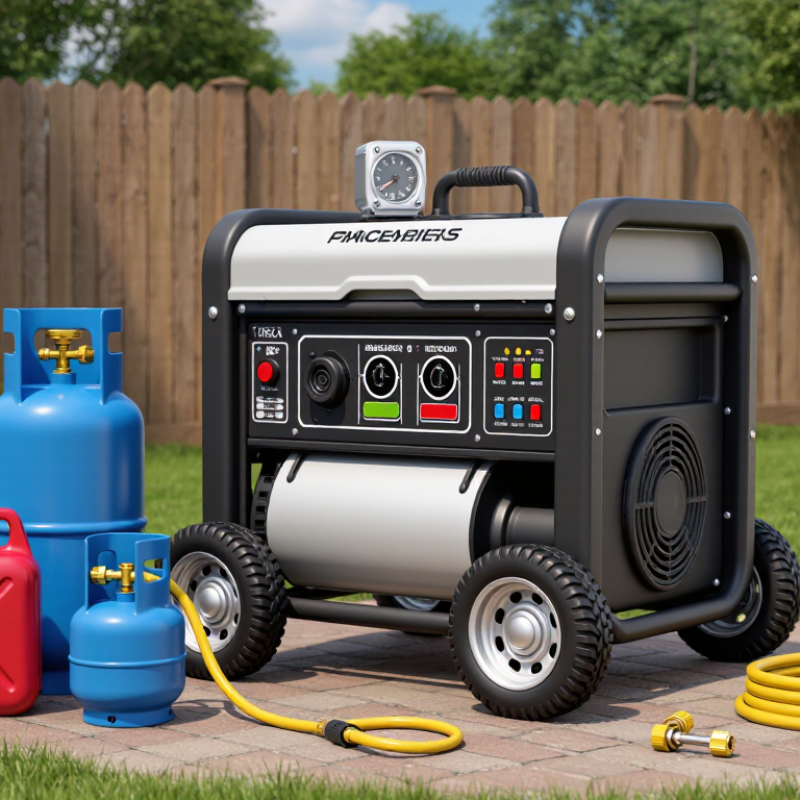
Define Load Size: Add Starting Surge and Keep 20% Capacity Headroom
Choosing a multi fuel generator starts with an honest load estimate, not the largest appliance in your home. List every device you may run during an outage, including lights, refrigeration, pumps, heating controls, and chargers.
Record each appliance’s running watts and starting watts. Motors in refrigerators, well pumps, and compressors can briefly demand two to seven times their running power. Add the highest starting surge to the combined running load of devices operating at the same time. Do not add every possible surge unless those appliances will start together.
For example, a refrigerator may run at 700 watts but need 2,100 watts at startup. A sump pump might use 1,000 running watts and require 2,500 watts briefly. If the selected running load reaches 4,000 watts, add the largest relevant surge, not every surge listed. Then keep at least 20% capacity headroom. That means a 4,000-watt operating load needs a generator rated around 5,000 watts before surge demands are considered.
Leave room for uncertainty.
I once underestimated a pump because its label showed only running watts. The generator worked, but voltage dipped when the pump started. A clamp meter or appliance manual can improve your estimate. Fuel type also affects available output, so check the generator’s rating for gasoline, propane, or natural gas separately. Recheck the calculation after adding a freezer, tool charger, or medical device. Small loads accumulate quickly.
2026 Multi-Fuel Generator Sizing Guide
Estimate generator capacity by adding the appliance's running load to its additional starting surge, then reserve 20% capacity headroom.
Formula: Recommended generator capacity = (Running watts + Starting surge watts) × 1.20. Values shown are typical appliance estimates; always verify actual nameplate ratings and manufacturer specifications.
Compare Fuels: Gasoline Delivers About 33.7 kWh per Gallon (EIA)
2026 Top Multi Fuel Generator Buying Guide
Gasoline remains a strong reference fuel when comparing multi-fuel generators. The U.S. Energy Information Administration estimates gasoline contains about 33.7 kWh per gallon. This describes fuel energy, not electricity delivered to your appliances. A generator loses energy through engine heat, friction, and conversion. Real output will be noticeably lower.
That difference matters during sizing. A refrigerator, freezer, lights, and small pump may create changing loads throughout the day. A 2,000-watt generator running continuously does not automatically provide 2 kWh every hour from gasoline. Its engine may cycle, idle, or consume more fuel during startup surges. Read the manufacturer’s fuel-use data at specific load levels. Check both running watts and starting watts. Small details matter.
Tips: Record your essential loads for three days. Note startup behavior, not only label wattage. Keep fuel in approved containers, away from heat and ignition sources. Rotate stored gasoline carefully, because old fuel can damage engine performance. Compare runtime at 25%, 50%, and 100% load when possible. My early estimates often looked too optimistic because I ignored idle losses and short, heavy surges. A spreadsheet helps, but it cannot replace a real load test. Consider gasoline’s energy density, storage limits, noise, and availability together. The cheapest fuel calculation may not be the most dependable choice during a long outage.
2026 Top Multi Fuel Generator Buying Guide - Compare Fuels: Gasoline Delivers About 33.7 kWh per Gallon (EIA)
Fuel energy, estimated consumption, storage considerations, and practical operating characteristics
| Fuel |
Approx. Energy Content |
Estimated Fuel Use
at 5 kW / 50% Load* |
Approx. Operating Time
from One Standard Unit* |
Storage Life and Handling |
Main Advantages |
Main Limitations |
| Gasoline |
About 33.7 kWh per U.S. gallon of energy |
Approximately 0.30 gal/hour |
About 3.3 hours from a 1-gallon tank |
Best used fresh; gasoline can degrade in storage, especially without stabilizer. Store only in approved containers. |
Widely available, easy to transport, and commonly supported by portable generators. |
Higher volatility, shorter storage life than diesel, and increased fire-safety requirements. |
| Diesel |
About 37.7 kWh per U.S. gallon of energy |
Approximately 0.27 gal/hour |
About 3.8 hours from a 1-gallon tank |
Generally stores longer than gasoline, but water contamination and microbial growth can still be concerns. |
High energy density, strong load-handling capability, and efficient operation under sustained loads. |
Heavier equipment, higher purchase and maintenance costs, and greater noise in many applications. |
| Propane (LPG) |
About 27.6 kWh per U.S. gallon of energy |
Approximately 0.36 gal/hour |
About 2.8 hours from a 1-gallon equivalent |
Does not degrade like gasoline and is stored under pressure in approved cylinders or tanks. |
Cleaner-burning than gasoline or diesel, convenient for long-term storage, and useful for emergency preparedness. |
Lower energy density, reduced performance in cold conditions, and dependence on cylinder availability. |
| Natural Gas |
About 30.3 kWh per 100 cubic feet of gas |
Approximately 33 cubic feet/hour |
About 3.0 hours per 100 cubic feet |
Delivered through a utility line, so there is little onsite fuel storage; service can be interrupted during disasters. |
No fuel cans or cylinders are required, and continuous supply is possible when the gas network remains available. |
Not portable, requires a suitable gas connection, and may provide less power on some engines than liquid fuels. |
How to Read the Estimates
*The fuel-use estimates are planning values for a 5 kW generator operating at approximately 50% load. They assume about 25% conversion of fuel energy into electrical energy. Actual consumption varies with generator design, engine condition, altitude, temperature, load level, and fuel quality.
Energy-content figures are approximate lower-heating-value comparisons based on commonly published U.S. Energy Information Administration fuel data. The 33.7 kWh-per-gallon gasoline figure represents fuel energy, not guaranteed electrical output.
Buying tip: Choose gasoline for broad availability, diesel for frequent heavy-duty operation, propane for longer storage, or natural gas when a dependable utility connection is more important than portability.
Check Power Quality: Select Units Below 5% THD for Sensitive Electronics
When choosing a multi-fuel generator in 2026, check power quality before fuel capacity or starting wattage. Total harmonic distortion, or THD, measures waveform distortion in the electricity supplied. For laptops, medical equipment, audio systems, and modern chargers, select a unit rated below 5% THD. Cleaner power reduces stress on sensitive components and helps prevent charging errors.
I test generators with a plug-in power meter and a realistic load, not only an empty outlet. Connect a laptop charger, LED lamp, and small motor separately. Watch the reading during startup and when switching between gasoline and propane. The waveform may change under load. This detail is easy to miss. A specification sheet can also hide test conditions, so verify whether the THD rating applies at full output.
I once trusted a low THD label without checking voltage stability. That was too simple. Fuel flexibility does not guarantee refined power. Look for overload protection, stable frequency, and clear maintenance instructions. Keep the generator outdoors, away from doors and windows, and use a properly installed transfer system when connecting household circuits. A qualified electrician should inspect that connection. Test the unit every few months, because stored fuel, dust, and neglected oil can affect performance. A calm test today is better than discovering unstable power during an outage.

 Sinotruk Parts
 Shacman Parts
 FAW Parts
 Dongfeng Parts
 Foton Parts
 CHENGLONG PARTS
 Golden Dragon Bus Parts
 King Long Parts
 Yutong Parts
 Higer Parts
 Zhongtong Parts
 Ankai Parts





 Mr. Perry Wu International Sales Director