Leave Your Message

Top 10 Small Diesel Engine Benefits and Applications?

The use of a small diesel engine has gained popularity across various industries. These engines are known for their efficiency and durability. They perform reliably under tough conditions, making them suitable for diverse applications.

Small diesel engines are commonly found in agricultural machines, generators, and construction equipment. They provide significant advantages, like better fuel economy and lower emissions compared to larger engines. Users appreciate their compact design, which saves space and allows for versatile installation options.

However, the adoption of small diesel engines is not without challenges. Some may find maintenance tricky or time-consuming. Additionally, addressing the environmental impact of diesel engines remains a point of reflection. Despite these concerns, the benefits often outweigh the drawbacks, making them a worthy consideration for many businesses.
Top 10 Small Diesel Engine Benefits and Applications?

Benefits of Small Diesel Engines in Efficiency and Longevity

Top 10 Small Diesel Engine Benefits and Applications?

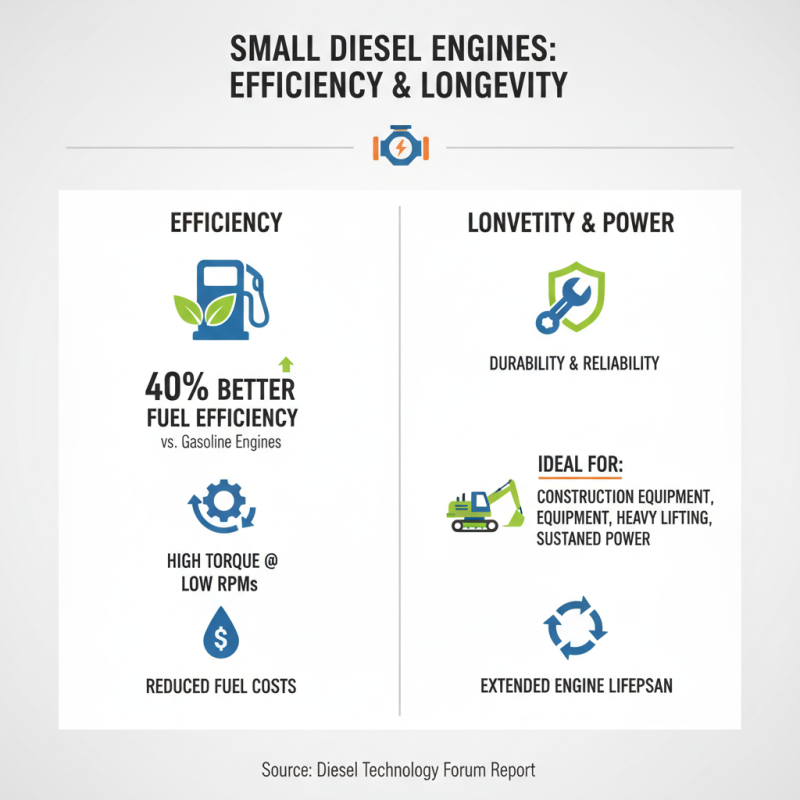
Small diesel engines are becoming more popular due to their efficiency and durability. According to a report from the Diesel Technology Forum, these engines can achieve up to 40% better fuel efficiency compared to gasoline engines. Their high torque at low RPMs makes them ideal for applications requiring heavy lifting or sustained power. Construction equipment often relies on these engines to operate effectively and efficiently, reducing fuel costs.

Longevity is another significant benefit of small diesel engines. Studies indicate that these engines can last up to 30% longer than their gasoline counterparts with proper maintenance. Their robust design allows them to handle more rigorous conditions. This durability is crucial for industries like agriculture and logistics, where downtime can lead to significant losses. Despite these advantages, the initial cost can be higher, raising questions about cost-effectiveness over time. Users must consider both the upfront investment and long-term savings.

Overall, the motivations for choosing small diesel engines lie in their efficiency and longevity. Industries are drawn to their ability to minimize operational costs while maximizing output. However, continual advancements in engine technology could shift the landscape. The potential for cleaner alternatives and improved efficiency promises a future worth watching.


Applications of Small Diesel Engines in Various Industries

Top 10 Small Diesel Engine Benefits and Applications?

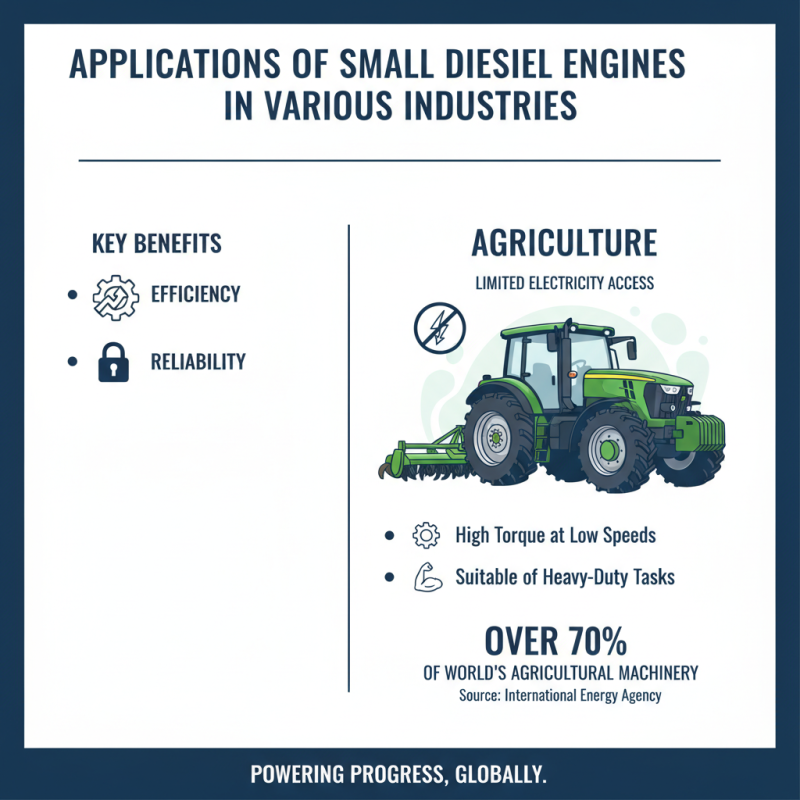
Small diesel engines play a crucial role in various industries due to their efficiency and reliability. In agriculture, these engines power equipment like tractors and tillers. According to the International Energy Agency, diesel engines contribute to over 70% of the world’s agricultural machinery. Their ability to generate high torque at low speeds makes them suitable for heavy-duty tasks, even in rural areas with limited access to electricity.

Construction sites also see a significant application of small diesel engines. These engines are often found in generators and compact machinery such as excavators and compressors. A report from MarketsandMarkets indicates that the global construction equipment market is expected to grow significantly, with diesel engines leading in segments needing durability and consistent power. While they are highly effective, the diesel engines emit pollutants, which poses environmental concerns and needs addressing.

In marine applications, small diesel engines drive safety and reliability in commercial fishing and transportation. The American Bureau of Shipping notes that these engines fuel over 50% of the world's marine vessels. However, the rising focus on emissions standards has led to discussions about transitioning to cleaner alternatives. The need for innovation in this space is critical, as industries strive for greener solutions while maintaining performance efficiency.

Cost-Effectiveness of Small Diesel Engines for Small Businesses

Small diesel engines present a cost-effective solution for many small businesses. Their fuel efficiency can lead to significant savings over time. According to a recent industry report, businesses can save up to 30% on fuel costs compared to gasoline engines. This makes them attractive for fleet operators and companies relying on heavy machinery.

Additionally, maintenance costs are generally lower for diesel engines. They have a longer life expectancy, often exceeding 10,000 hours of operation. This longevity translates to fewer replacements and repairs. However, it’s essential for businesses to invest in proper maintenance practices. Skipping maintenance can lead to higher expenses in the long run.

Despite the advantages, there are downsides to consider. Diesel engines can be louder and produce more emissions initially. Some businesses may need to adapt by investing in noise reduction technologies or emission controls. This creates an added upfront cost, which may deter some. Balancing these factors is crucial for making informed decisions about engine choices.

Top 10 Small Diesel Engine Benefits and Applications

Environmental Impact and Emission Standards of Small Diesel Engines

Small diesel engines are crucial in various applications, especially in transportation and agriculture. They offer unique advantages such as fuel efficiency and durability. However, their environmental impact raises concerns. Diesel engines emit nitrogen oxides (NOx) and particulate matter (PM), which can harm air quality. Reports suggest that these emissions significantly contribute to urban pollution. A study shows that small diesel engines can produce up to 30% more NOx compared to gasoline engines.

To address these issues, stringent emission standards have been implemented. Regulations like the European Union’s Stage V aim to reduce harmful exhaust emissions from these engines. The standards require advanced technologies such as selective catalytic reduction (SCR) and diesel particulate filters (DPF). These innovations can lead to a considerable decrease in NOx and PM emissions, making small diesel engines cleaner. Despite progress, compliance can be a challenge for manufacturers. The costs associated with these technologies can limit their adoption, especially in developing markets.

The balance between functionality and environmental responsibility remains a complex issue. Small diesel engines still have a role in many industries, but their emissions require constant monitoring and improvement. Continuous innovation is essential to ensure they meet current and future environmental standards. Adjustments in policies and practices are necessary to minimize their ecological footprint while maintaining performance efficiency.

Top 10 Small Diesel Engine Benefits and Applications

Benefit/Application Description Environmental Impact Emission Standards
Fuel Efficiency Small diesel engines are known for their high fuel efficiency compared to gasoline engines. Lower fuel consumption leads to reduced carbon emissions. Meets Euro 6 standards for particulate matter and nitrogen oxides.
Durability Designed for longevity, small diesel engines can operate for thousands of hours with proper maintenance. Longer lifespan reduces waste and resource consumption. Typically exceeds emissions durability requirements.
Torque Small diesel engines provide higher torque at lower RPMs, enhancing performance in heavy-duty applications. Efficient power delivery helps reduce energy consumption. Complies with stringent torque emission regulations.
Versatility Small diesel engines can be used in various applications such as generators, pumps, and vehicles. Supports multiple sectors, promoting eco-friendly technology use. Adheres to sector-specific emission standards.
Lower CO2 Emissions Diesel engines produce significantly lower CO2 emissions than gasoline engines under similar conditions. Contributes to climate change mitigation efforts. Aligned with global agreements on emissions reductions.
Availability of Fuel Diesel fuel is widely available and can often be more affordable than gasoline. Easier access to fuel promotes sustainable energy practices. Regulated for commercial and private use efficiency.
Biodegradable Options Newer technologies are adapting to use biodiesel, which is biodegradable and renewable. Reduce ecological footprints compared to traditional fuels. Meets alternative fuel standards for emissions.
Fuel Storage Diesel can be stored for longer periods compared to gasoline without degradation. Less frequent disposal needed, reducing environmental hazards. Aligned with standards for storage safety.
Safety Diesel fuel is less volatile than gasoline, making it safer to handle. Reduces the risk of accidents related to fuel combustion. Follows strict safety compliance guidelines.
Lower Maintenance Costs Smaller diesel engines often require less frequent maintenance than gasoline engines. Promotes economic sustainability for users. Maintains compliance with maintenance emission restrictions.

Technological Advancements in Small Diesel Engine Design and Performance

The evolution of small diesel engines is remarkable. Engine efficiency has significantly improved. Innovations in fuel injection systems are driving these changes. The use of common rail direct injection (CRDI) enhances fuel atomization. A recent report highlighted an increase in fuel economy by up to 25%.

Another notable advancement is the reduction in emissions. Advanced turbocharging technologies are making engines cleaner. According to a study, emissions have decreased by up to 40% compared to older models. Small diesel engines now meet strict emission standards.

While developments are impressive, challenges remain. Engine noise and vibrations still concern many users. Some designs are not fully optimized for all conditions. Continued innovation is essential to address these issues. As technology progresses, small diesel engines can become even more versatile. The potential applications in various sectors remain vast.